


Combat Veteran, Navy Orthopaedic Surgeon Receives OREF Clinical Research Award for On-the-Ground Research Leading to Evolution of Battlefield Orthopaedic Care, Reduced Morbidity and Mortality
NEW ORLEANS (March 4, 2026)—Captain Dana C. Covey, Medical Corps, United States Navy (Ret.) MD, MSc, FAAOS, FAOA, was honored with the 2026 Orthopaedic Research and Education Foundation (OREF) Clinical Research Award for 30 years of study on how team preparation, logistics and far-forward patient treatment have led to improved outcomes for battlefield musculoskeletal injuries and reduced mortality. The evolution of on-the-field care, including leaner, more mobile surgical teams, improved military vehicular design and the widespread use of body armor and modern tourniquets, has helped contribute to the lowest case fatality rate in history for the wars in Iraq and Afghanistan.[i]
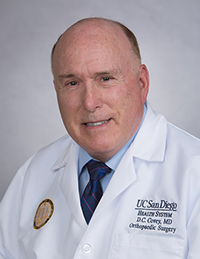
Captain Dana C. Covey, Medical Corps, United States Navy (Ret.) MD, MSc, FAAOS, FAOA
Download Image
To read more about the award, please click here.
Approximately 52,143 service members were wounded in the Iraq and Afghanistan wars, the majority of whom sustained musculoskeletal injuries.[ii], [iii] A multitude of interconnected advancements, including enhanced training for battlefield surgeons, improved body armor, surgical advances, early blood transfusions, and rapid medical evacuation, contributed to a 44% reduction in mortality and improved treatment of life-and-limb-threatening musculoskeletal injuries.[i]
“We’ve made significant developments in the last several decades to help lower the rate of fatalities from combat injuries,” said Dr. Covey, clinical professor of orthopaedic surgery at University of California San Diego, and also a surgeon at VA San Diego Healthcare System. “I spent 40 years in the Navy and have been through various conflicts, documenting lessons from each that could be applied to battlefield care. We have endeavored to implement orthopaedic recommendations to evolve treatments, leading to increased survivability and improved musculoskeletal outcomes.”
Battlefield Advancements Increase Survivability
Based on the experience of Dr. Covey and colleagues combined with ongoing studies and research by others, the U.S. military surgical teams made changes to the strategies, systems and equipment to reduce the extent of combat injuries.
One of the largest improvements was to the design of combat vehicles. During the Balkans Civil War in the 1990s, lumbar burst fractures with lower extremity injuries were seen in vehicle occupants wounded by antitank mines. Those sitting in the vehicle experienced an axial spinal load transmitted by the vehicle as it accelerated upward from a blast, resulting in anterior and posterior compression failure of the vertebral body.[iv] Subsequent studies showed that changing the vehicle design from a flat bottom to a V-hull could significantly reduce fatalities and orthopaedic injury rates from under-vehicle explosions.[v] This design modification was implemented for the wars in Iraq and Afghanistan and is still in use today.
In Afghanistan in 2011, the Pelvic Protection System (PPS), which is a two-tiered system of personal pelvic and junctional (transition points of the body) protection, was introduced to help reduce the severity of blast trauma to soldiers. In a study by Dr. Covey, a cohort of 36 service members who sustained at least one traumatic above-knee amputation in Afghanistan and wore the PPS saw significantly fewer (p=0.012) junctional/perineal injuries.[vi]
To better prepare deploying surgical personnel, teams underwent training that simulated real-field conditions. Covey led a prospective study of 51 military patients who elected to undergo ambulatory surgery in a modified field surgical hospital with an environment and equipment that mirrored the battlefield. The training proved to be valuable. At the two-year follow-up, no patients experienced anesthetic, bleeding, infectious or other significant perioperative complications.[vii] To further this training, Dr. Covey and colleagues from each service presented battlefield information at the inaugural Extremity War Injuries Symposium, in 2006, to showcase best practices for state-of-the-art care for patients with combat trauma and prepare military orthopaedic surgeons to treat injuries on the battlefield.
Innovation in On-Field and Off-Field Treatments and Practices Saves Limbs and Lives
The widespread use of modern tourniquets to treat extremity wounds has made a large impact on the survival of soldiers injured in combat. A study of 232 injuries in Iraq found that tourniquet use was strongly associated with survival (90% vs. 10%; p<0.001).[viii] A prospective study by Dr. Covey and Christopher E. Gentchos, MD, FAAOS orthopaedic surgeon at Concord Hospital in Concord, N.H. during the Iraq War showed that tourniquets applied for penetrating injuries with severe bleeding reduced transfusion requirements and helped maintain adequate blood pressure.[ix] Those with effective tourniquets had less hemorrhage from penetrating orthopaedic injuries (p=0.001) and significantly higher mean systolic and diastolic blood pressures. These findings supported another study that showed increased tourniquet use helped reduce mortality.
“The use of tourniquets to treat combat injuries has been a major advancement,” said Dr. Covey. “All the troops now carry a Combat Action Tourniquet, which can be applied with one hand if someone has an injured limb on the battlefield. The standardization of instrumentation across the different services has helped a lot and has been a key learning from previous conflicts.”
In the 1990s, surgeons began an approach called damage control surgery (DCS) to treat civilian patients with traumatic injuries to limit initial operative interventions for unstable patients until they can improve and withstand prolonged surgery. This approach led to damage-control orthopaedics (DCO), which minimizes stress on the body by quickly stabilizing fractures followed by physiologic optimization before patients undergo definitive reconstruction, rather than pushing for urgent, definitive orthopaedic surgery, as evidence showed an increase in complications among critically ill patients.[x]
Utilizing DCO, complications can be reduced by preventing multisystem organ failure and acute respiratory distress syndrome through immediate hemorrhage control, permissive hypotension and urgent surgical treatment to include rapid provisional fracture stabilization to prevent the dangerous triad of coagulopathy, hypothermia and acidosis (a condition in which there is too much acid in body fluids).[xi] Rapid medical evacuation to a facility that can provide a higher level of intensive care follows to stabilize patients’ vitals before further orthopaedic surgery. DCO has become the model for treatment of patients with severe combat trauma.
“One of the most important aspects of multi-disciplinary research is that we’ve been able to increase the survivability of combat patients and we have improved orthopaedic outcomes through expert care early on, setting the stage for a better definitive surgery down the line with better functional outcomes,” said Dr. Covey. “The advancements in body armor have increased service members’ chances for survival. In previous conflicts such as in Vietnam, vests that were worn could stop fragments and some-low velocity gunshot wounds. However, the newer body armor worn in the Iraq and Afghanistan wars can protect against higher-velocity bullets and fragments, and has made a marked difference in terms of survivability.”
There have been advancements in the care of combat veterans with orthopaedic injuries once they return home. New techniques for the fixation of open, comminuted, battlefield fractures having large zones of injury and soft-tissue loss are being developed. Recent progress in surgery for brachial plexus injuries has improved the previously poor prognosis for those sustaining combat-related brachial plexus wounds. Enhanced data collection of musculoskeletal injuries sustained in combat will help guide future treatment decisions. Challenges continue past the acute care phase of battlefield orthopaedic trauma, with many patients requiring rehabilitation and post-acute services, such as mental healthcare, to optimize recovery and reintegration back into military service and everyday life.
“I’ve seen many veterans in my practice and peer support has been shown to be extremely important for wounded warriors, especially amputees,” said Dr. Covey. “Peer support helps veterans get through the trauma and rehabilitation phases.”
###
About AAOS
With more than 39,000 members, the American Academy of Orthopaedic Surgeons is the world’s largest medical association of musculoskeletal specialists. AAOS is the trusted leader in advancing musculoskeletal health. It provides the highest quality, most comprehensive education to help orthopaedic surgeons and allied health professionals at every career level to best treat patients in their daily practices. AAOS is the source for information on bone and joint conditions, treatments, and related musculoskeletal healthcare issues; and it leads the healthcare discussion on advancing quality.
Follow the AAOS on Facebook, X, LinkedIn, and Instagram.
Disclosure/Funding and Conflicts of Interest
For a list of disclosures, funding and conflicts of interest, email media@aaos.org.
For more information, contact:
| Nicole Winston-Ramirez | 847-384-4162 | winston-ramirez@aaos.org |
| Deanna Killackey | 847-384-4035 | killackey@aaos.org |
[I] Howard, JT, Kotwal RS, Stern CA, et al. 2019. Use of combat casualty care data to assess the US military trauma system during the Afghanistan and Iraq conflicts, 2001-2017. JAMA Surgery. 154(7):600-8.
[ii] U.S. Department of Defense. Casualty Status. https://www.defense.gov/casualty.pdf. Published Jan. 30, 2025. Accessed Jan. 12, 2026.
[iii] Owens, BD, Kragh JF, Wenke JC, et al. 2008. Combat wounds in Operation Iraqi Freedom and Operation Enduring Freedom. J Trauma. 64(2):295–299.
[iv] Covey DC, Lurate RB, Hatton CT. 2000. Field hospital treatment of blast wounds of the musculoskeletal system during the Yugoslav civil war. J Orthop Trauma. 14:278-86.
[v] Ramasamy A, Hill AM, Masourosa SD, 2011. Evaluating the effect of vehicle modification in reducing injuries from landmine blasts. An analysis of 2212 incidents and its application for humanitarian purposes. Accident Anal Prevent. 43: 1878– 1886.
[vi] Covey DC. 2023. Decreasing lower extremity junctional and perineal injury from explosive blast with a pelvic protection system. Injury. 54(7):110784.
[vii] Tounzon J. 2012. NMCSD debuts bioskills training center. Navy Marine Corps Med News. 2012; May:8.
[viii] Kragh JF Jr, Walters TJ, Baer DG, et al. 2009. Salinas J, Holcomb JB. Survival with emergency tourniquet use to stop bleeding in major limb trauma. Ann Surg. 249(1):1-7.
[ix] Covey DC, Gentchos CE. 2022. Field tourniquets in an austere military environment: A prospective case series. Injury. 53(10):3240-7.
[x] Mathieu L, Bazile F, Barthélémy R, et al. 2011. Damage control orthopaedics in the context of battlefield injuries: the use of temporary external fixation on combat trauma soldiers. Orthop Traumatol Surg Res. 97(8):852-9.
[xi] Stevens NM Tejwani NC. 2024 Damage-control orthopedics or early total care: What you need to know. J Trauma. 96(5):694-701.